 028a7e4adf
Some checks failed
CI / ci (pull_request) Has been cancelled
Reframes pruning as skill extraction: telegram-voice, telegram-images, and browser-jail become opt-in skill packages instead of deletions. - Import dependency analysis: 3,200 lines browser (orphaned), 383 lines Telegram voice/images (live paths), with hidden-core deps mapped - Three approaches evaluated: event bus, config-gated, build-flag - Recommendation: config-gated for TS, trait-based for Colibri Rust - Browser family: delete (already dead, glasspane supersedes) - 7 open questions for agent input |
||
|---|---|---|
| .agent | ||
| .archive | ||
| .github | ||
| .pi/extensions/clawdie-harness | ||
| agent | ||
| bin | ||
| bootstrap | ||
| config-examples | ||
| doc | ||
| docs | ||
| groups | ||
| hooks | ||
| html | ||
| infra | ||
| jail | ||
| launchd | ||
| ports/clawdie | ||
| repo-tokens | ||
| scripts | ||
| setup | ||
| skills-engine | ||
| src | ||
| .crowdin.yml | ||
| .env.core.example | ||
| .env.example | ||
| .gitignore | ||
| .graphifyignore | ||
| .mcp.json | ||
| .npmrc | ||
| .nvmrc | ||
| .prettierrc | ||
| AGENTS.md | ||
| ARCHITECTURE.md | ||
| CHANGELOG.md | ||
| CLAWDIE-ISO.md | ||
| CLAWDIE.md | ||
| CONTRIBUTING.md | ||
| CONTRIBUTORS.md | ||
| CROWDIN.md | ||
| crowdin.yml | ||
| DB_ADMIN_AGENT.md | ||
| GIT_ADMIN_AGENT.md | ||
| IDENTITY.md | ||
| justfile | ||
| LICENSE | ||
| MEMORY.md | ||
| package-lock.json | ||
| package.json | ||
| README-CLAWDIE.md | ||
| README.md | ||
| README_zh.md | ||
| setup.sh | ||
| SOUL.md | ||
| stop-clawdie.sh | ||
| SYSADMIN_AGENT.md | ||
| system.env.example | ||
| tsconfig.json | ||
| tsconfig.setup.json | ||
| USER.md | ||
| vitest.config.ts | ||
🦞 Clawdie
Personal AI Assistant on FreeBSD
A lean, secure AI assistant running on FreeBSD 15 with native jail isolation.
Documentation • Website • Codeberg


38.4k tokens · 19% of context window • built-in knowledge · preloaded
Overview
Clawdie is a FreeBSD-first personal AI assistant with a host-side Node.js orchestrator and jailed agent execution. The core repo stays small, Telegram is built in, and additional channels or integrations are added through skills instead of being hard-wired into core.
V2 Track
The main branch stays focused on the current working system. The
multitenant branch is the internal V2 track where Clawdie is refactored into
a host platform that can run tenant assistants such as atlas or bob.
That branch is for architecture work, not a feature race. The goal is to make ownership, recovery, degraded mode, and FreeBSD-native multitenancy explicit before any wider public launch.
Current Release
v0.10.0 (04.apr.2026)
Domain Defaults Fix
See Changelog for full release notes.
Key Features:
- 🏠 Native FreeBSD - No Linux emulation, native jail isolation
- 🔒 Jail Isolation - Secure OS-level containers with ZFS snapshots
- ⚡ Better Performance - Single layer: FreeBSD → Jail → Node.js
- 💾 ZFS Integration - Snapshots, quotas, compression, RAIDZ1 support
- 🌐 Multi-Language Docs - English, German, French, Spanish (Crowdin-managed)
- 📚 Zero-Downtime Deployments - Symlink-based versioning with instant rollback
- 🔄 Automated Sync - Daily documentation compilation & deployment @ 05:00 UTC
- 🔧 Cloud & Baremetal - ISO variants for VPS (headless) and physical hardware (GUI)
- 🔐 SSH Keys & Passwords - Pre-configured or interactive setup options
- 🔧 CNC Ready - clawdie-cnc for CNC machine control (in development)
Why Clawdie?
Why Jails Instead of Docker?
| Aspect | Docker on FreeBSD | FreeBSD Jails |
|---|---|---|
| Performance | Good (emulation overhead) | Excellent (native) |
| Layers | FreeBSD → Linux → Docker | FreeBSD → Jail |
| Security | Good | Excellent |
| Networking | Docker bridge | Native IP |
| Complexity | High | Low |
| ZFS Integration | Manual | Native |
Result: Simpler, faster, more secure.
Why Clawdie?
NanoClaw by Gavriel is the upstream line we still track, and NanoClaw itself follows the broader OpenClaw direction opened by Peter Steinberger. Clawdie takes that line onto FreeBSD for operators who want:
- Native performance without Linux emulation
- ZFS integration for snapshots and quotas
- Simpler architecture (fewer layers)
- CNC machine integration for manufacturing
Architecture
Telegram + scheduled tasks + IPC
  ↓
PostgreSQL ops database (messages, groups, tasks, sessions)
  ↓
Host orchestrator (Node.js)
  ↓
FreeBSD worker jail(s)
  ↓
Agent response
Single Node.js process. Agents execute in isolated FreeBSD worker jails with filesystem isolation via nullfs mounts. Only mounted directories are accessible. Per-group message queue with concurrency control. PostgreSQL defaults to host runtime (DB_RUNTIME=host) with platform-owned system_* databases: built-in skills/reference knowledge, user/agent memory, and operational state. A dedicated db jail remains available when explicitly selected. Ops + memory are required; the built-in skills artifact is committed and can be refreshed with just refresh-skills-artifact when docs or skills change.
Key Files
src/index.ts— orchestrator: state, message loop, agent invocationsrc/hostd/— privileged host daemon (types, ops, daemon, client)src/controlplane.ts— self-healing: checks hostd, service jails, PF; repairs via hostdsrc/watchdog.ts— memory throttle, run mode, control plane timersrc/channels/telegram.ts— built-in Telegram channelsrc/group-queue.ts— per-group queue with global concurrency limitsrc/agent-runner.ts— spawns jailed agent processessrc/mount-security.ts— mount allowlist enforcementsrc/task-scheduler.ts— scheduled taskssrc/db.ts— PostgreSQL ops (messages, groups, sessions, state, routing)setup/*.ts— modular setup entrypointssetup/service.ts— generatesrun-*.shwrappers at install time (not tracked in git)groups/*/AGENTS.md— per-group memory
A justfile provides discoverable command shortcuts. Run just (or just --list) to see all recipes. Prefer just for interactive work; npm run <name> remains for CI and scripting. The full installer is intentionally exposed as just install / npm run install:clawdie instead of the npm lifecycle name install.
Common mappings:
just install              # npm run install:clawdie
just install-from-db      # npm run install:clawdie -- --from db
just setup-db             # npm run setup -- --step db
just setup-cms            # npm run setup -- --step cms
What It Supports
- Telegram-first core - Built-in Telegram channel plus headless/background operation.
- Isolated group context - Each group has its own
AGENTS.mdmemory, isolated filesystem, and runs in its own jail sandbox with only that filesystem mounted. - Main channel - Your private channel (self-chat) for admin control; every group is completely isolated.
- Scheduled tasks - Recurring jobs that run the AI agent and can message you back.
- Jail isolation - Agents are sandboxed in FreeBSD jails with ZFS snapshots.
- Split-brain memory - PostgreSQL stores three platform-owned databases by default:
system_skillsfor preloaded reference knowledge,system_brainfor user/agent memory, andsystem_opsfor messages, tasks, sessions, routing, and runtime state. - Built-in payments, optional extras - Stripe ships in core and is ready when configured; other channels and integrations can still be layered through skills.
Installation
Prerequisites
- FreeBSD 15.x
- ZFS root installation
- Root access or sudo
- Internet access for
pkgandnpm bashandgitavailable before first runjust— command runner (pkg install juston FreeBSD; preinstalled on Clawdie ISO)- At least one agent CLI on
PATH: one ofpi,aider,claude,codex, orgemini. The controlplane harness uses Aider+Pi as the primary driver. Onboarding fails fast if none are present (seedoc/AGENT-CLI-VALIDATION.mdfor the validated install paths). The Clawdie ISO ships claude/gemini/pi via the npm-globals bundle, aider viapy311-aider_chatpkg, and codex viapkg install codex.
Recommended explicit host baseline before first run:
sudo pkg install -y bash git bastille node24 npm tmux btop python311 uv ripgrep fd-find rsync postgresql18-client py311-pillow dejavu py311-aider_chat edk2-bhyve just
The edk2-bhyve package provides UEFI firmware required for optional browser-vm support
(FEATURE_BHYVE_GUI=YES in .env).
On FreeBSD, use fd-find. It provides the fd command that pi expects and
avoids colliding with the unrelated fd file manager package.
The host baseline also includes py311-pillow and dejavu so tmux screenshot
capture works without a separate uv pip install Pillow step.
If the host still has both Python 3.11 and 3.12 installed, pin uv to 3.11
explicitly until the generic python3 path is cleaned up:
uv venv --python 3.11
uv run --python 3.11 <command>
Operator Glasspane
The local operator cockpit lives in scripts/glass.sh.
On a root/platform install it uses the tmux session name glasspane. On a
tenant install it uses <tenant>-glasspane.
# create and attach
sh scripts/glass.sh

# create without attaching (safe smoke test)
GLASS_ATTACH=0 sh scripts/glass.sh

# remove the glasspane session
sh scripts/glass.sh kill
On FreeBSD, keep fd-find installed. It provides the fd command that pi
expects inside the glasspane session.
First use:
- Start it with
sh scripts/glass.sh. - Window
0(glass) containspion the left andaideron the right. - Window
1containsbtop. - Switch windows with
Ctrl-b 0andCtrl-b 1. - Move between panes with
Ctrl-bthen an arrow key. - Detach without killing the session with
Ctrl-b d. - Reattach later with
tmux attach -t glasspane. - Stop the session with
sh scripts/glass.sh kill.
Quick Start
# 1. Install the recommended FreeBSD host baseline
sudo pkg install -y bash git bastille node24 npm tmux btop python311 uv ripgrep fd-find rsync postgresql18-client py311-pillow dejavu py311-aider_chat just

# 2. Clone the repository
git clone https://codeberg.org/Clawdie/Clawdie-AI.git /home/clawdie/clawdie-ai
cd /home/clawdie/clawdie-ai

# 3. Bootstrap repo dependencies and hooks
./setup.sh

# 4. Ensure at least one agent CLI is on PATH (onboarding gates on this).
#    Pick whichever you use; the ISO bundle installs all supported CLIs offline.
pi --version >/dev/null 2>&1 || npm install -g @earendil-works/pi-coding-agent
# Optional alternates:
#   npm install -g @anthropic-ai/claude-code   # claude
#   npm install -g @google/gemini-cli          # gemini
#   sudo pkg install -y codex                  # codex (FreeBSD pkg)

# 5. Run the canonical install orchestrator
just install

# 6. If a step fails, fix the cause and resume from that step
just install-from-db

# 7. Validate the result
just doctor
If the host still has the old fd file manager package installed, pkg will
replace it with fd-find. That replacement is the intended FreeBSD baseline.
just install is the supported full path. The lower-level setup/index.ts steps remain available for debugging and targeted recovery, but new installs should prefer the orchestrator so checkpoints and resume behavior stay consistent.
PI Profiles
pi-tui uses a single PI_TUI_PROFILE selector for common runtime scenarios:
setup— onboarding and exact setup actionsoperator— normal daily runtimestatus— read-only health/status summariespayments— Stripe-safe support flowdocs— docs and release copycms— Astro/Strapi publishing workgit— local git mirror and upstream syncmemory— split-brain and PostgreSQL memory worklocal— Ollama/offline fallbackcnc— CNC machine operation and G-code work
Check the resolved profile state with:
just setup -- --step pi-config
pi-config validates the active provider through Pi auth in
~/.pi/agent/auth.json, provider env vars in .env, or OLLAMA_HOST
for local Ollama.
List all built-in profiles with:
just setup -- --step pi-config --list-profiles
The split-brain database path is mandatory. Setup generates or preserves the
PostgreSQL and Strapi secrets in .env, then keeps SKILLS_DB_URL,
MEMORY_DB_URL, and OPS_DB_URL aligned with AGENT_NAME, subnet, and
passwords. The db step applies three distinct schema tracks:
- built-in knowledge tables in the skills DB
- dynamic hybrid-memory tables in the user/agent memory DB
- operational state tables in the ops DB (messages, tasks, sessions, routing)
The db step also imports the shipped built-in knowledge artifact by default.
skills-memory --import remains available as a manual re-import path. Maintainers refresh the committed artifact with just refresh-skills-artifact; the wrapper detects docs/skills/identity changes and checks OpenRouter budget before regenerating embeddings.
At runtime, the host queries the local skills DB before each jail run and
prepends the top built-in references to the prompt when relevant.
The active mandatory pieces are:
POSTGRES_ADMIN_PASSWORDSKILLS_DB_PASSWORDMEMORY_DB_PASSWORDOPS_DB_PASSWORDCONTROLPLANE_SHARED_SECRET
For PostgreSQL identifiers, the root install uses the shared platform namespace
system, independent of ASSISTANT_NAME or AGENT_NAME. Platform databases
use system_skills, system_brain, system_ops, system_git, and
system_web. Later additive tenants get their own <tenant>_* databases.
STRAPI_DB_PASSWORD and the STRAPI_* app secrets feed the default internal
Strapi bootstrap inside the cms jail. They are generated
automatically if missing and should stay private to the CMS layer.
npm run preflight-check writes a full host validation bundle into
tmp/preflight/<stamp>/, including summary.json and summary.env for
the on-host agent. It includes telegram-auth in the default sequence;
groups and register remain post-deployment follow-up work
and no longer block base install verification on a fresh host.
Clawdie provisions local code hosting by default through the dedicated git
jail. The default mode is:
CODE_HOSTING_MODE=gitFEATURE_GIT=YESWARDEN_GIT_IP=<subnet>.2
The git step creates the shared git jail by default (GIT_JAIL_NAME can
override it), installs the git jail baseline, creates /srv/git, and mirrors
the current repository into a bare repository.
Default IP Layout
The repo registry/default examples use 10.0.1.x; live installs can override
this through .env with another private /24 such as 192.168.72.x. For a
running system, live jail state and .env are authoritative; this table is the
provisioning/default slot map from infra/jails.yaml:
.1gateway onwarden0.2git/ Git Service.3cms/ Web Service.4Local AI Models (ollamaorllama.cpp, if enabled).5optionaldb/ Data Service whenDB_RUNTIME=jail.6browser/ Browser Execution Template.101+workers.211DB admin worker.212Git admin worker.213coordinator worker.150+ephemeral browser task clones
This keeps foundational services low in the range while leaving room for multiple workers and avoiding overlap with host-facing web services. The CMS stack stays on the private jail network instead of assuming control of host nginx, which is the main reason the low fixed service slots matter.
Naming and Local DNS
Current main separates public and internal naming:
AGENT_DOMAINis the public-facing site/API domainAGENT_INTERNAL_DOMAINis the internal jail/service zone written into/etc/hosts
Fresh installs should keep public and internal names separate:
AGENT_DOMAIN=until you have a real public DNS name configuredAGENT_INTERNAL_DOMAIN=<agent>.home.arpafor local jail/service names
Why this changed:
.localis reserved for mDNS and is a bad default for private service naminghome.arpais the safer standards-based internal namespace- keeping public and internal names separate avoids accidentally treating a non-public jail hostname as if it were externally routable
FreeBSD Milestone
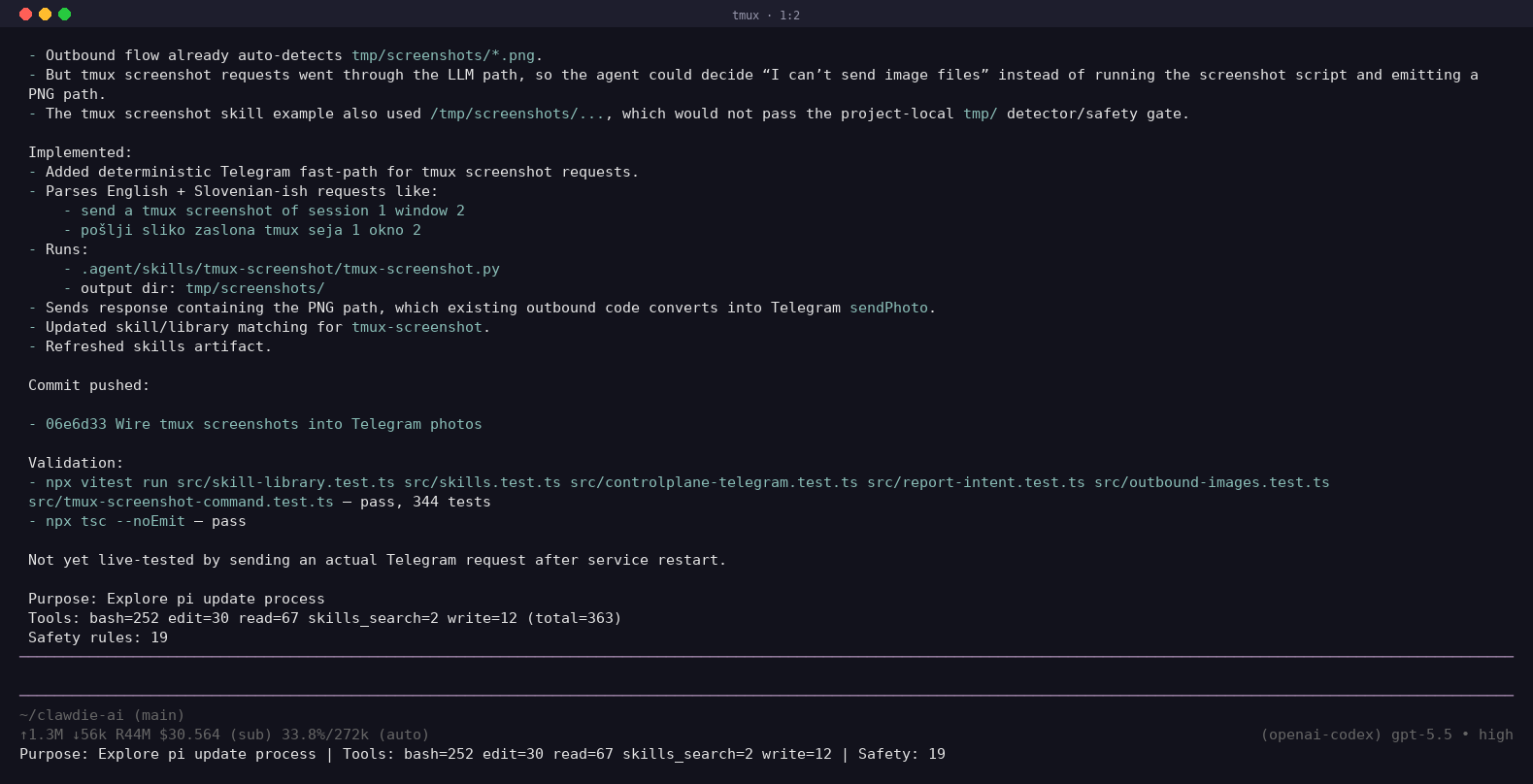
Example tmux screenshot generated by Clawdie and sent as a Telegram photo
Current runtime centers on:
- host-side orchestration in
src/index.ts - service-owned shared infrastructure (
clawdieservice,system_*platform resources) - Bastille worker jails from
src/jail-config.ts just installas the canonical install orchestrator- mandatory DB bootstrap with built-in knowledge import when the artifact is present
Simple Install Flow
./setup.sh
  -> bootstrap repo dependencies and hooks
just install
  -> read first-boot setup seed or run onboarding fallback
  -> configure environment, pi, PF, jails, services, hostd
  -> provision Data Service, Git Service, Web Service when enabled
  -> verify install and report warnings
ASSISTANT_NAME is display-only. The root install remains the shared platform:
service name clawdie, platform namespace system, and no root TENANT_ID.
groups and register remain explicit follow-up steps after auth/state are
present; they are not part of the minimal first-boot path.
Stripe Flow
onboarding
  -> configure Stripe now? (or skip)
  -> write STRIPE_SECRET_KEY into .env
host agent-runner
  -> reads STRIPE_SECRET_KEY from .env
  -> passes it to jailed runtime in stdin JSON secrets payload
jailed agent runner
  -> merges secret into SDK env only
  -> registers Stripe MCP tools
agent chat
  -> can use payment, customer, invoice, and subscription tools
Web Serving
nginx runs inside the Web Service (cms jail). By default, setup/pf.ts configures Warden egress (NAT) only; public ingress (PF rdr) is intentionally opt-in so Clawdie does not take over host ports 80/443 unexpectedly. Strapi (when used) is internal-only by default.
Operational docs for this milestone:
- Bastille on FreeBSD 15
- Jail Networking Strategy
- PostgreSQL Memory Plan
- Monitoring Model
- Manual Reset and pi-tui Rebootstrap
Usage
Talk to your assistant with the trigger word (default: @Clawdie):
@Clawdie send an overview of the sales pipeline every weekday morning at 9am
@Clawdie review the git history for the past week each Friday and update the README
@Clawdie every Monday at 8am, compile news on AI developments and message me a briefing
Run just doctor to check system health (runtime, jails, networking, services, DNS resolver probes, TLS certificate expiry, ACME renewal cron, morning-report schedule, and split-brain DB/artifact status). Exit codes: 0 = ok or warnings, 1 = error.
TLS Certificate Lifecycle
Public edge certificates are managed by acme.sh on the FreeBSD host and installed under /usr/local/etc/nginx/ssl/<label>/. The TLS setup step is safe by default:
# Non-mutating local validation: acme binary, cron, nginx -t, webroots, challenge routes, cert parsing
sudo npx tsx setup/index.ts --step tls --smoke-test

# Repair/install lifecycle without forcing issuance: install acme.sh, install cert hooks, write /etc/cron.d/clawdie-acme
sudo npx tsx setup/index.ts --step tls --apply

# Force-renew one cert only when deliberately validating or recovering before expiry
sudo npx tsx setup/index.ts --step tls --apply --cert clawdie --force-renew
just doctor reports TLS_<LABEL> days remaining and ACME_RENEWAL_CRON status. Do not force-renew repeatedly; Let’s Encrypt rate-limits duplicate certificates.
From the main channel (your self-chat), you can manage groups and tasks:
@Clawdie list all scheduled tasks across groups
@Clawdie pause the Monday briefing task
@Clawdie join the Family Chat group
Telegram Commands
A short selection — for the full reference (status, structured reports, runtime, sessions, admin actions, free-text routing) see Operator Commands.
| Command | Description | Auth |
|---|---|---|
/status |
System summary: jails, ZFS, PF, budget, model | anyone |
/report |
Structured system + auth report | admin |
/disk |
Structured ZFS pool + snapshot report | admin |
/tasks |
Structured controlplane task report | admin |
/budgetreport |
Structured budget + token analytics | admin |
/publishreport |
Structured tenant publish/content report | admin |
/testreport |
Structured build + test status (from wrapper-written JSON) | admin |
/policy |
Default runtime, per-chat overrides, fallback cooldowns | anyone |
/usage |
Per-agent token budget breakdown | anyone |
/clearcooldown |
Clear a provider fallback cooldown | ops chat |
/compact |
Compact session (summarize old, keep recent turns) | admin |
/new |
Hard reset session, start fresh | admin |
/stop |
Kill running agent mid-response | admin |
/tts |
Toggle voice replies (on/off/status/default) | admin |
/activation |
Set trigger mode (always/mention) | admin |
/whoami |
Show your Telegram identity | anyone |
/help |
List available commands | anyone |
The bot also routes free-text ops phrasings ("disk usage", "are the tests passing", "task report", etc.) to the matching structured report instead of the LLM path — see Structured Reports → Free-Text Routing.
Session Compaction
When a conversation grows past the byte limit (AGENT_SESSION_MAX_BYTES), old turns are automatically summarized via the LLM and stored in the memory database. The session file is rewritten with a compaction header + last N turns at full fidelity. Manual compaction is available via /compact.
Cost Model
Budget enforcement has been removed (26.maj.2026). DeepSeek prefix caching at ~98% hit rate makes per-chat token budgets unnecessary.
Text-to-Speech
Clawdie uses Microsoft Edge TTS (free, no API key) to generate voice replies. Configured via TTS_AUTO_MODE:
always— every reply gets a voice messageinbound— reply with voice when user sends a voice notetagged— only when agent output contains[[tts]]markeroff— no voice messages
Per-chat override via /tts command.
Customizing
Clawdie doesn't use configuration files. To make changes, just tell the AI agent what you want:
- "Change the trigger word to @Assistant"
- "Remember in the future to make responses shorter and more direct"
- "Add a custom greeting when I say good morning"
- "Store conversation summaries weekly"
Or run /customize for guided changes.
The codebase is small enough that the AI agent can safely modify it.
Philosophy
Small enough to understand. One process, a few source files, no microservices. If you want to understand the full Clawdie codebase, ask the AI agent to walk you through it.
Secure by isolation. Agents run in FreeBSD jails with filesystem isolation via nullfs mounts. They can only access explicitly mounted directories. Bash access is safe because commands run inside the jail, not on your host.
Built for the individual user. Clawdie isn't a monolithic framework; it's software that fits each user's exact needs. You make your own fork and have the AI agent modify it to match your requirements.
Customization = code changes. No configuration sprawl. Want different behavior? Modify the code. The codebase is small enough that it's safe to make changes.
AI-native.
- FreeBSD installs can start with
npm run wizardfor optional interactive locale, timezone, and assistant-first onboarding.bsddialogis used when present; plain TTY prompts are the fallback. The selector uses FreeBSD's locale inventory, so you can choose any installed locale (for exampleen_US.UTF-8orzh_CN.UTF-8) and it is applied the same way as the default. - The rest of setup remains modular and scriptable through
just setup -- --step ...(ornpm run setup -- --step ...). - No monitoring dashboard; the harness shows status and the AI fills in the details.
- No debugging tools; describe the problem and the AI fixes it.
Skills over features. Instead of adding features (e.g., support for Telegram) to the codebase, contributors submit skills like /add-telegram that transform your fork. You end up with clean code that does exactly what you need.
Documentation System (Phase 3.0+)
v0.9.0 includes a complete multi-language documentation deployment system:
Architecture
Markdown Source (git)    →    Crowdin (translate)    →    Daily Sync (05:00 UTC)
     ↓                              ↓                              ↓
docs/public/*.md (English)    →    docs/public/{de,fr,es}/* →    docs-v0.9.0_24.mar.2026/
                                                          ├─ en/
                                                          ├─ de/
                                                          ├─ fr/
                                                          └─ es/

Symlink Swap (atomic, zero-downtime)
     ↓
https://docs.clawdie.si/{en,de,fr,es}/
Features
- Markdown Source of Truth — English docs in
docs/public/*.md, auto-synced to Crowdin - Crowdin Integration — Translators work on crowdin.com/project/clawdie-ai
- Automated Sync — Daily cron @ 05:00 UTC compiles markdown → HTML for all languages
- Zero-Downtime Deployment — Symlink-based versioning with atomic swaps
- 30-Day Retention — Old versions auto-cleaned, instant rollback available
- No External Dependencies — Pure shell compilation (no pandoc, no external tools)
Quick Links
- docs-deployment skill — Complete operations guide
- CROWDIN.md — Translation workflow
- Integration Guide — How build (clawdie-shell) and deployment (clawdie-ai) work together
Supported Languages
- 🇬🇧 English (source, always current)
- 🇩🇪 Deutsch (German)
- 🇫🇷 Français (French)
- 🇪🇸 Español (Spanish)
Want to add more languages? Update scripts/docs-sync.cron.sh and add to Crowdin.
Clawdie Ecosystem
| Component | Description | Status |
|---|---|---|
{AGENT_NAME}-worker |
Default Bastille worker jail profile | Current |
| skills-memory bootstrap | Precomputed pgvector import for the skills DB | Current |
| docs-deployment | Multi-language docs with Crowdin sync (Phase 3.0+) | Live |
| clawdie-cnc | CNC machine control | Development |
| browser-vm | Browser automation profile in jail config | Planned |
| docs.clawdie.si | Documentation site (4 languages) | Live |
CNC (clawdie-cnc)
Clawdie-cnc is the control system for the CNC machine — an open source machine designed to manufacture geodesic dome components. It translates dome designs from OSA into G-code, manages the build sequence, and logs everything to persistent memory.
See clawdie-cnc/README.md for details.
Contributing
Don't add features. Add skills.
If you want to add Slack support, don't create a PR that adds Slack alongside Telegram. Instead, contribute a skill file (.agent/skills/add-slack/SKILL.md) that teaches the AI agent how to transform a Clawdie installation to use Slack.
Users then run /add-slack on their fork and get clean code that does exactly what they need, not a bloated system trying to support every use case.
Available Skills (35+)
Channels: add-telegram, add-discord, add-gmail, add-slack, add-voice-transcription, x-integration
Jail & Infrastructure: warden-bootstrap, warden-pf, warden-zfs, warden-health, bastille-network, browser-vm, freebsd-admin, sanoid
Operations:
- nginx — CMS jail vhost management
- nginx-glasspane — Nginx security features
- docs-deployment — Multi-language documentation sync (NEW v0.9.0)
- telegram-admin, tmux-screenshot, postgres-memory
Frontend & CMS: astro, strapi
Agent: coding-agent, add-telegram-swarm, add-parallel
Utility: setup, update, customize, debug
Skills Structure
.agent/skills/add-telegram/
├── SKILL.md           # Skill documentation and instructions
├── manifest.yaml      # Skill metadata
├── add/               # Files to add
│   └── src/channels/telegram.ts
├── modify/            # Files to modify
│   └── src/config.ts
└── tests/             # Skill tests
    └── telegram.test.ts
Requirements
- FreeBSD 15.x
- Node.js 24+
- Python 3.11+ (for voice transcription, screenshots, and other features)
- ZFS (required for Bastille jails)
- Optional: Telegram bot token, provider API key, PostgreSQL URLs for memory/skills DB
Security
Agents run in FreeBSD jails with filesystem isolation, not behind application-level permission checks. They can only access explicitly mounted directories. The codebase is small enough that you can review it. See docs/public/operate/security.md for the full security model.
Documentation
- docs.clawdie.si - Complete documentation (English, Deutsch, Français, Español)
- docs/public/architecture/host-operator-model.md - Host-first operator model and service-jail layout
- .agent/skills/docs-deployment/SKILL.md - Documentation deployment system (Phase 3.0+)
- .agent/skills/docs-deployment/INTEGRATION.md - Cross-repo integration guide (clawdie-ai ↔ clawdie-shell)
- CROWDIN.md - How to translate and contribute translations
- AGENTS.md - Agent development guidelines
Community
Questions or ideas? Open an issue on Codeberg or reach out at hello@clawdie.si.
Acknowledgments
Clawdie is built on giants' shoulders. Peter Steinberger created OpenClaw, which set the broader project line. NanoClaw by Gavriel distilled that line into a minimal personal-assistant upstream. Clawdie is the FreeBSD-first fork in that lineage.
We keep NanoClaw as an upstream reference where it helps, then carry the design into native jails, ZFS, PF, and the wider OSA mission.
License
BSD 3-Clause License
Copyright (c) 2026, Sam (Samo Blatnik)
Redistribution and use in source and binary forms, with or without modification, are permitted provided that the following conditions are met:
- Redistributions of source code must retain the above copyright notice, this list of conditions, and the following disclaimer.
- Redistributions in binary form must reproduce the above copyright notice, this list of conditions, and the following disclaimer in the documentation and/or other materials provided with the distribution.
- Neither the name of the copyright holder nor the names of its contributors may be used to endorse or promote products derived from this software without specific prior written permission.
See LICENSE for full text.
Clawdie · Personal AI Assistant on FreeBSD
clawdie.si · docs.clawdie.si
Built on giants' shoulders · FreeBSD-first